
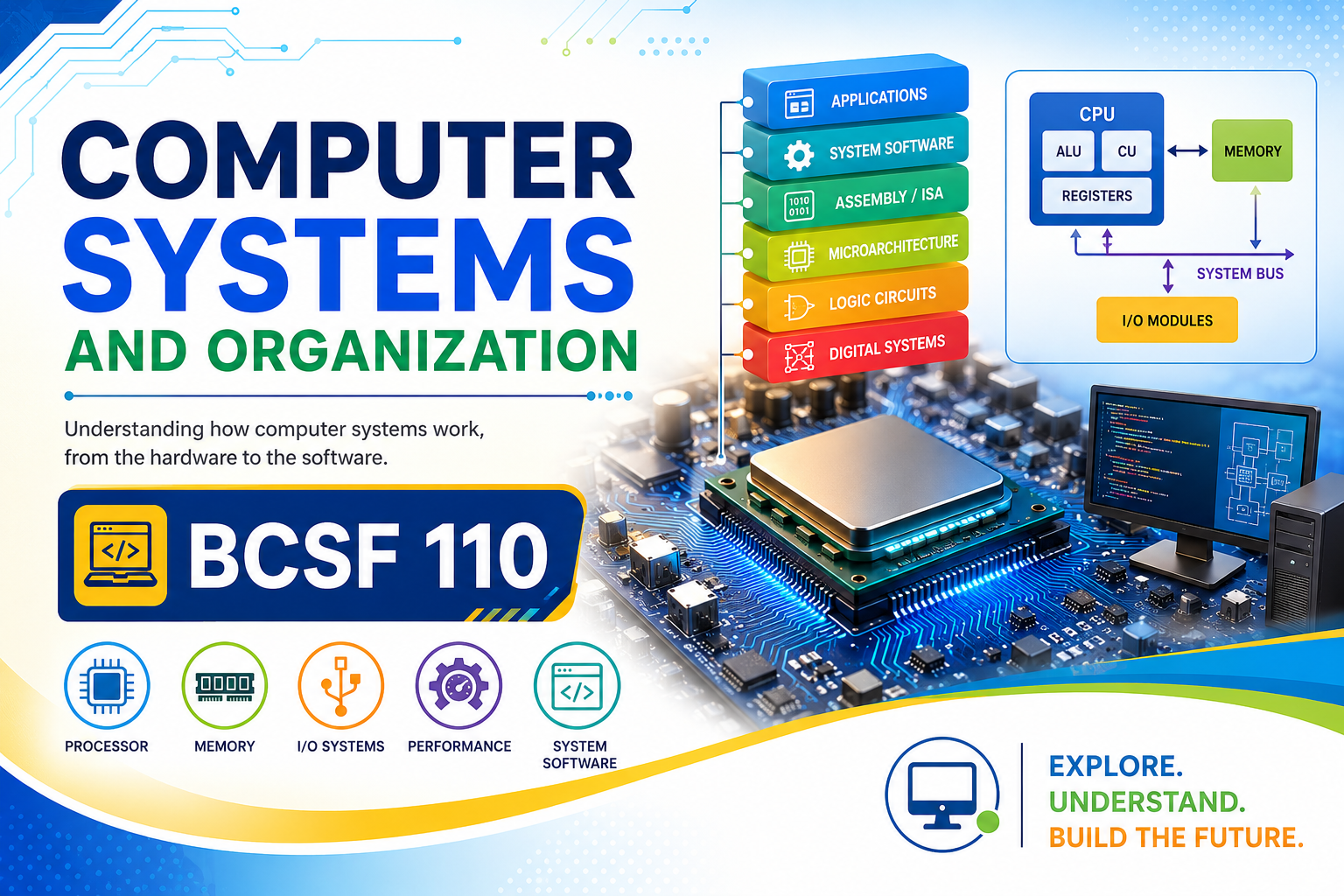
Course Summary: This course introduces students to the fundamental principles underlying the organization and operation of computer systems. It examines how data are represented, how the CPU processes instructions, how arithmetic and logic operations are performed, how memory is organized, how input/output devices communicate with the processor, and how pipelining improves performance.
Course Learning Outcomes:
By the end of the course, the learner should bae able to:
- Explain the fundamental components, organization and architectural principles of computer systems, including CPU, memory, I/O and system buses.
- Represent and manipulate data using number systems, data representation formats, digital logic and computer arithmetic techniques.
- Analyse how instructions are transferred, decoded and executed through registers, micro-operations, instruction sets and control-flow mechanisms.
- Evaluate memory, I/O and processor-performance mechanisms, including memory hierarchy, DMA, interrupts, pipelining and pipeline hazards.
- Apply computer organization and architecture concepts to solve practical problems and investigate contemporary issues in cybersecurity, digital forensics and computer systems, using appropriate computational and GenAI tools critically and responsibly.
- Teacher: Prof. Mzee Awuor